Can Ruminating Together Drive Action?

A quantitative study of how political co-rumination relates to political action among college students
By: Becky Berg | Independent Researcher | In completion of Master’s Thesis at Columbia University | July 2024 - May 2025.
How co-rumination works
Co-rumination is a conversational dynamic in which two people repeatedly ruminate on a problem together, without reaching a clear outcome or resolution.
Characterized as a trade-off, not only can co-rumination create emotional strain for both parties, it can conversely strengthen intimacy and social bonding.


My Research Question
Can the co-rumination dynamic motivate outward, actionable behaviors?
My study focused on a context-specific form of co-rumination centered on a political-social level issue, called political co-rumination.
My Hypothesis
Based on social influence, political co-rumination increases the likelihood that participants engage in various political actions.

Methods
This was a cross-sectional, self-report, quantitative study.
Select the arrows to expand my methodology in detail.
Participants were asked to think about a person they talk to the MOST about social/political issues and to keep them in mind for the co-rumination questions.
They rated five statements on a 5-point scale (from not at all true to very true) describing their co-ruminative conversations. They answered these questions twice: first, reflecting on their own behavior (self), then on how they perceived their conversation partner’s behavior (partner).
Next, from a list of 25 political actions, participants were asked to rate their engagement with each one in the past year on a 4-point scale (ranging from never to often).
Participants were recruited through Columbia University and Barnard College Sona Recruitment Systems psychology subject pool.
Participants had to be 18 years or older.
Sona Systems - for recruitment.
Qualtrics - for web-based survey.
R Studio- for data cleaning, analysis, and modeling.
This study examined the relationship between political co-rumination and political action.
For each participant:
A mean composite political co-rumination score was calculated by averaging the 5 self-reported items and the 5 perceived partner co-rumination items.
A composite political action score was calculated as the mean response across all 25 political action items and treated as a continuous variable.
Pearson correlations and simple linear regression models were used to assess the relationship between these variables.
Data was collected January - March 2025
The study procedure was approved by the Columbia University IRB Exp on 12/10/2024.
Before consenting, participants were informed that:
Participation was risk-free.
They could skip questions or cease participation at any time.
No identifiers would be collected.
Data will be securely stored and encrypted in Qualtrics.
Participant Demographics

Total participants
193

Gender identity
88.11% women
Age range
18 to 32 (M = 19.7, SD = 2)

Race
33.95% white/caucasian

College status
97.86% undergraduate students, of which 44.92% are freshmen

Living situation
42.70% living in student housing
Key Findings
Political co-rumination is associated with political actions.
WHAT I FOUND
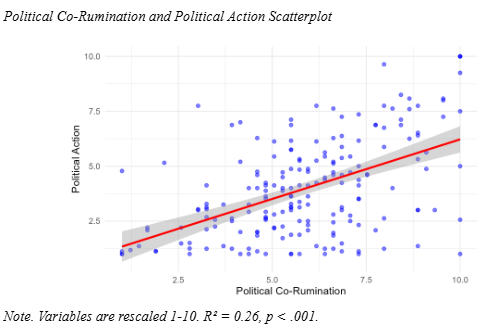
A moderately strong positive relationship between political co-rumination and political action, as measured by Pearson correlation, r(193) = 0.51, p < .001.
This, and other data, indicated that participants who spent more time engaging in intimate political discussions were more likely to take political actions, such as voting or promoting a political movement.
BACKING DATA

Implication
Conversations that are intimate, repetitive, and inconclusive can drive outward behaviors that can cascade to larger socio-cultural movements.

How social apps can use it:
Tech products that rely on behavior (e.g., learning, wellness, civic, or habit-forming platforms) should treat conversation as a primary application for users rather than a supplementary add-on.
Friendships are preferred for intimate political conversations.
WHAT I FOUND
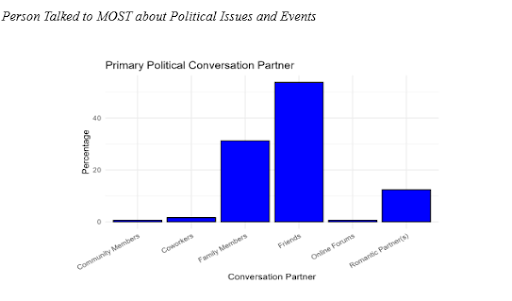
Over 50% of participants chose to have intimate political discussions with friends rather than family members or romantic partners.
BACKING DATA
Implication
Friendships offer trust and intimacy without the commitment of a romantic partner or family member. Inflammatory topics, like politics, are more likely to be sought out among friends who offer a personable level of familiarity but carry less emotional baggage when conflict arises.
How social apps can use it:
Design interactive features that allow users to engage with trusted friends for emotional support, such as shared progress, collaborative goals, or private group spaces.
Why This Study Matters
The results of this study show that co-rumination can extend beyond the interaction and influence real-world behaviors that could cascade to broader cultural movements.
However, at this point, it's unknown which aspect of co-rumination truly motivates outward behavior. Does relational intimacy outweigh problem irresolution, or do participants seek action to fulfill the irresolution, regardless of intimacy?
Trends Observed without Statistical Significance
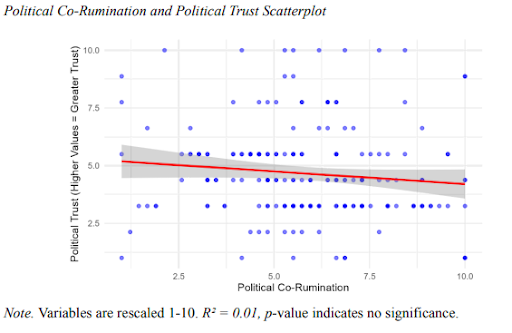
My original study also included how political co-rumination related to underlying attitudes such as:
perceived political alignment with a partner
trust in the government
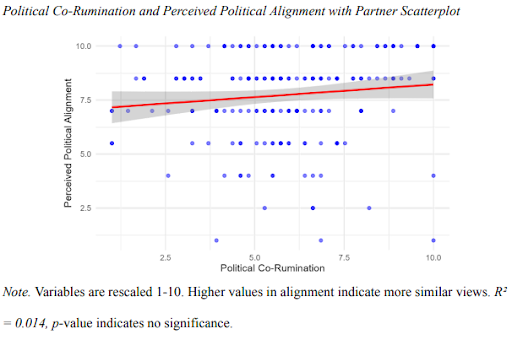
Because these results were statistically inconclusive, any claims are unjustifiable. However, the trends are worth examining:
TREND OBSERVED
Students are more likely to engage in political co-rumination with someone who shares more similar political views to them, as indicated by the positive trend in the data analysis.
BACKING DATA
TREND OBSERVED
Political co-rumination reduces students’ trust in the government, as indicated by the negative trend in the data analysis.
BACKING DATA
Personal Learnings and Insights

The Daily Diary would be a more apt approach
Conversational nuances are best captured with the daily diary method. This delineates the problem of participants having to recall long past conversations.

Timing is key
Because the political climate constantly shifts, it’s important to recognize that data may change in response to political discourse. For instance, if data were collected before the elections, rather than after, conversational outcomes may change.

Expanding ‘friend’, for more context
Given that the majority of participants are students living in student housing (42.70%), it’s questionable whether the choice of ‘friend’ as the conversation partner was interpreted as roommate or classmate. Nuanced collegiate social dynamics could have been better captured if these options had been listed.

Pooling from other universities
This sample represents a private Ivy League university system located in a predominantly liberal, urban setting. Future iterations of this study would include pooling from different institutional types or from different geopolitical regions in the United States.
Downloadables and Research Materials
Note: Files are provided to demonstrate research rigor, transparency, and analytical workflow rather than for independent reuse. To balance transparency with participant privacy, select materials are publicly available, with additional documentation available upon request.
Study Instruments:
Study Questionnaire (Portfolio Subset)
IRB-approved instrument; selected measures analyzed in this study. Full IRB-Approved Survey - Available Upon Request.
Data & Analysis:
Cleaned/De-identified dataset - Available Upon Request
Sample R Analysis Scripts
Analysis Outputs - Available Upon Request